
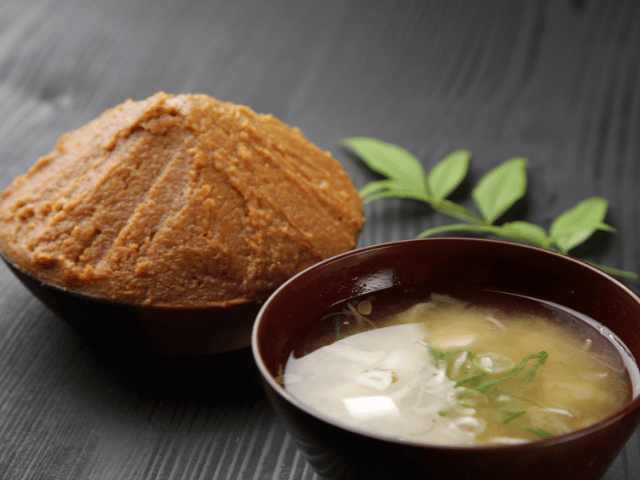
Did you know that there is a food that can greatly reduce the risk of breast cancer with just three cups a day?
Most Japanese people have eaten this food at least once in their lives.
Let’s take a look at “certain foods” that have cancer-preventive effects.
What is a cancer-preventive superfood?
The super food is “miso.
Most Japanese people have probably had miso at least once.
How many people know that miso, which is so familiar to Japanese people, has the ability to greatly reduce the risk of cancer?
I am ashamed to admit that I did not know until I did my own research.
If you are like me and didn’t know, please learn about the “hidden power of miso.
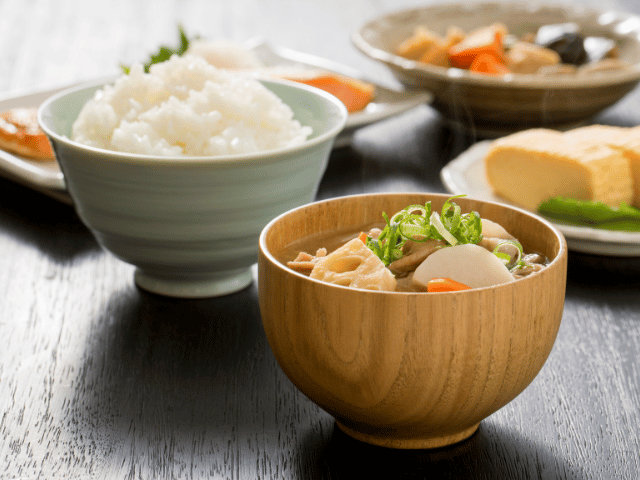
What is the risk of cancer lowered by 3 cups a day?
It has been announced that 3 cups of miso soup a day “reduces the risk of breast cancer by 40%.
40% is a very large number, and if you want to reduce your breast cancer risk as much as possible, you may want to try it.
Although three cups a day may be difficult to achieve, let’s start with one cup a day and continue!
The reason for this is also due to data showing that the more miso you consume, the lower your risk of breast cancer.
Therefore, if three cups a day is not feasible, one or two cups a day is fine.
Of course, even if it is difficult for you to have miso every day, just know that it is better to consume as much as possible, and actively try to drink miso soup whenever you have the opportunity!
↑upThis is enough.
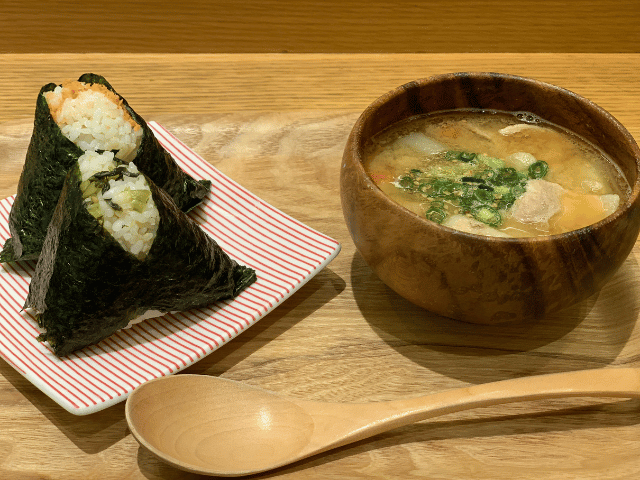
Did people in the past have miso soup every day?
Your grandparents, mothers, and fathers generation take a look!
Didn’t they make miso soup at home every day?
Food culture was not as westernized as it is today, and Japanese food would have been served on the table more often than not.
You probably had miso soup at breakfast time and miso soup at dinner as well.
There were probably more fish than meat.
It is said that such traditional Japanese food was good.
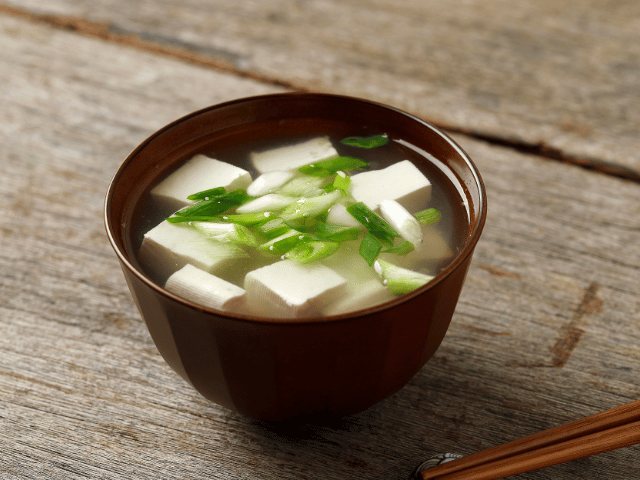
Major Changes in Dietary Culture
Have you noticed that there is a big difference between “old-fashioned dining” and “modern dining”?
When I was a child, most of the food served at home was Japanese food.
Dinner was not pizza, hamburgers, etc.
I remember that there was a lot of white rice, miso soup, vegetable dishes, fish dishes, pickles, natto (fermented soybeans) 、、、、、, etc.
The “modern dining table” has changed drastically from the old days.
This is due to a variety of factors, including the westernization of food, the increasing number of parents working together and the difficulty of finding time to cook at home, the increase in the number of places where food can be easily purchased, the abundance of frozen and retort-pouch foods that can be prepared in a short amount of time, and the spread of delivery services.
What is the risk of cancer that can be lowered by miso?
Drinking miso soup can be expected to prevent “stomach cancer” and “breast cancer.
It is believed that the isoflavones contained in the soybeans in miso have a cancer-preventive effect.
The mortality rate from stomach cancer is approximately 50% lower among men who drink miso soup every day than among men who do not drink miso soup at all. (A nationwide survey of approximately 270,000 people).
According to a survey of women, a group with higher blood levels of a type of isoflavone called genistein was less likely to develop breast cancer. This genistein is found in miso and soybean miso. (Results of a 10-year follow-up of approximately 20,000 women aged 40-59)
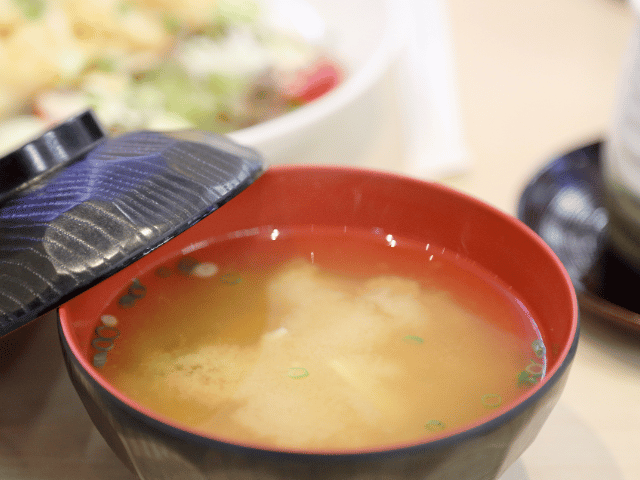
Can miso soup improve sleep?
Drinking miso soup seems to help improve sleep.
The miso used in miso soup contains a sleep-promoting substance called tryptophan.
When this tryptophan is ingested, “melatonin,” which promotes sleep, is secreted.
By improving sleep, it is possible to regulate lifestyle habits and reduce the risk of lifestyle-related diseases and obesity.
Is miso all about benefits for the body?
Doesn’t it somehow lead to excessive salt intake?
The salt content of miso soup is not a concern.
The amount of salt in a bowl of miso soup is a little more than that of a “rice ball plum”. Each bowl of miso soup contains about 1.9g of salt. (Of course, it depends on the type of miso)
This is less salt than one Big Mac (about 2.6 g.) The daily salt intake is less than 7.5 g for men and 6.5 g for women, and less than 6 g for prevention and treatment of high blood pressure.
*Three cups of miso soup per day would be a bit excessive in terms of this salt concentration. 3 cups of miso soup per day has been reported to “reduce the risk of breast cancer by 40%. ←This is a lot of salt concentration.
Perhaps the salt concentration in miso is not that important to be concerned about as much as these results are published. (If you are also concerned about the salt content of miso, a low-sodium miso is probably a good choice.)

Consume vegetables at the same time as miso
There should be few people who drink miso soup without any ingredients.
Although you may like or dislike some of the ingredients in miso soup, you can add your favorite vegetables, seaweed, tofu, etc. to keep yourself going.
I can especially recommend miso soup with plenty of vegetables.
If you can have this for breakfast, you can enjoy the nutrients of vegetables, dietary fiber, and a satisfied stomach…all good things.
Add your favorite ingredients and start with a goal of one cup every day!
Summary
I had no idea that miso had such power until I did my own research this time.
To be honest, if I had known this, I would have eaten miso soup more actively every day.
Let’s all take this opportunity to learn about the power of miso and make use of it in our daily health and lifestyle, and let’s all try to live our daily lives so as not to get cancer!